No products in the cart.


Deals
Store Discounts Feel Different Online
The same discount can feel trustworthy in a store and questionable online depending on how people experience the product.
Share
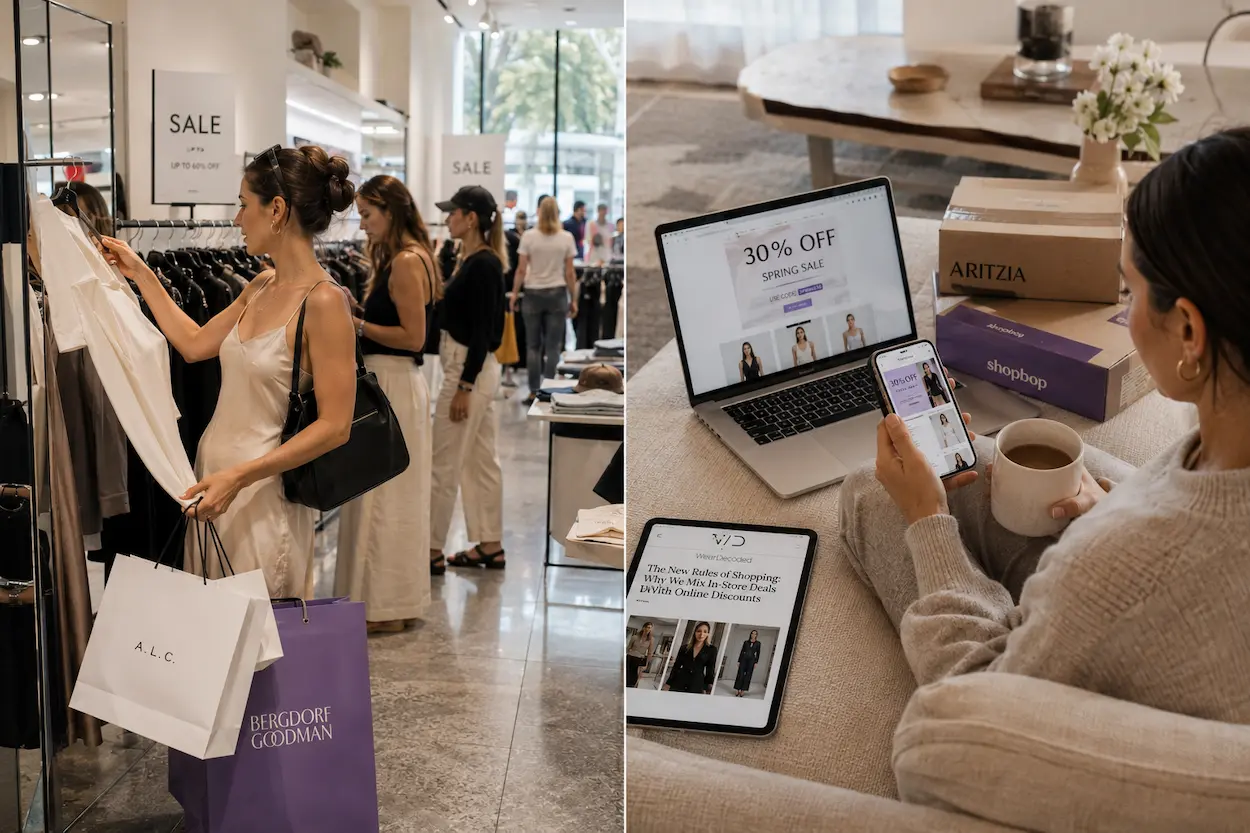
A 30% discount does not feel emotionally identical online and inside a physical store, even when the final price is exactly the same.
Inside retail spaces, shoppers judge value through direct experience. They touch fabric, check stitching, compare fit under mirrors, notice garment weight, observe how products are displayed, and decide whether the quality actually supports the branding surrounding it. The decision feels physical before it feels financial.
Online shopping operates differently.
Most ecommerce deals rely on urgency signals instead of physical confirmation:
countdown timers,
limited-stock warnings,
creator styling,
flash-sale banners,
algorithmic recommendations,
and repeated reminders designed to accelerate purchasing decisions before hesitation appears.
That difference is quietly changing shopping behavior.
People trust discounts more when they can touch the product first.
wearDecoded
Consumers Now Move Between Both Worlds
Many shoppers no longer treat physical and digital retail as separate experiences.
Someone may discover a product online first, save it during a sale, then visit a store later to check quality before purchasing. Others try clothing physically inside stores and wait for online discounts afterward because ecommerce pricing often changes faster than in-store pricing structures.
The modern customer constantly moves between convenience and confirmation.
That behavior became more common because consumers learned how different products can feel once they leave controlled product photography and enter real life. Edited campaign images may create interest initially, but physical stores still provide something the internet cannot fully replace:
immediate verification.
People trust their own observation more than marketing once they interact with the product directly.
Deal Psychology Is Becoming More Complicated
.Consumers are also becoming more skeptical of discount culture itself.
Endless sale banners, artificial markdowns, inflated “original” pricing, and aggressive urgency tactics trained many shoppers to question whether online discounts are genuinely valuable or simply engineered to trigger faster checkout decisions emotionally.
Trust became harder to manufacture.
That does not mean ecommerce stopped working. Online shopping remains faster, easier, and often more convenient than visiting stores physically. But shoppers increasingly recognize how digital presentation influences perception before they fully evaluate product quality itself.
Physical stores slow that process down.
Someone holding a jacket under ordinary lighting immediately notices details impossible to understand completely online:
fabric stiffness,
lining quality,
fit accuracy,
texture,
construction,
and whether the piece actually feels worth the discounted price.
Those small reactions shape loyalty more than many brands openly discuss.
Physical Retail Still Creates Emotional Confidence
Interesting stores understand that discounts alone rarely create trust long-term.
Atmosphere matters too:
how products are folded,
how staff interact,
how mirrors are positioned,
how fitting rooms feel,
whether the store environment supports confidence instead of pressure.
The retail experience changes how people interpret value.
That is partly why some shoppers still prefer buying discounted products physically even when online pricing appears identical. The store removes uncertainty. Customers stop imagining the product and start evaluating reality directly.
Good retail spaces reduce doubt.
The internet often accelerates excitement. Physical retail still helps confirm whether that excitement survives contact with the actual product.
Shopping Behavior Is Becoming More Hybrid
Modern shopping culture increasingly blends digital convenience with physical reassurance.
Consumers scroll first.
Research later.
Visit stores.
Compare prices.
Save screenshots.
Wait for discounts.
Check creator reviews.
Then sometimes return to the same product weeks later before deciding.
The path to purchase became less linear than traditional retail systems expected.
WearDecoded is interested in documenting how deal culture, ecommerce behavior, retail psychology, and physical shopping experiences continue reshaping consumer trust across modern fashion environments.
People trust discounts differently when they can physically confirm the product before buying.
Retailers, creators, photographers, and contributors exploring changing shopping behavior or retail culture can reach out through the WearDecoded Contact Page or email .
Shopping behavior, pricing strategies, and consumer trust patterns vary across retailers, ecommerce platforms, brands, and regions over time.






Related Articles

Deals
The Fitting Room Matters More
Discounts may trigger the purchase, but fitting rooms usually decide whether the...

Deals
Good Brands Need Better Placement
A strong product inside the wrong environment usually disappears faster than a...




Leave a comment